

The Invisible Hand Behind Humanoid Robot Mass Production
Precision Grinding at the Limits of Manufacturing
When tolerances fall into the single-digit micrometer range, the grinding wheel is no longer just a consumable - it becomes part of the manufacturing system.
Humanoid robots are moving from laboratory prototypes toward high-volume production. Market attention often centers on AI models and industrial design, yet many of the true manufacturing bottlenecks lie at the micron scale. Critical joint components - including planetary roller screws for linear force and strain-wave gear reducers for rotary motion - are pushing hardware production toward its physical limits. One of the less visible technologies determining whether these components can be produced accurately and repeatably is the precision grinding wheel.
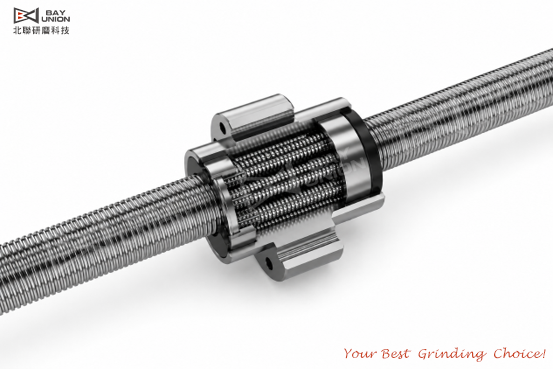
Planetary roller screw assemblies convert rotary motion into compact, high-force linear motion for demanding actuator applications.
Micron-Level Geometry Inside the Robot Joint
Machining these components is a direct contest with material hardness, deep internal geometry, and microscopic error. In an inverted planetary roller screw, fine, high-accuracy internal threads must be finished within a narrow, deep bore. After heat treatment, conventional cutting alone can struggle to deliver the required thread profile, pitch accuracy, surface finish, and process stability. Internal thread grinding therefore becomes a decisive finishing operation.
In this application, the grinding wheel is not a routine consumable. Its abrasive system, bond, structure, and dressed profile directly influence thread geometry, flank form, pitch accuracy, and surface roughness. Even slight wheel-profile wear - or micro-vibration caused by a long, slender grinding quill - can be transferred into the thread. In a humanoid hand or joint actuator, these deviations may appear as abnormal noise, uneven motion, reduced positioning accuracy, or shortened component life.
What Production-Grade Internal Thread Grinding Requires
- Machine and spindle rigidity. Deep-bore internal thread grinding demands a purpose-built machine concept, a dynamically stable spindle and quill, controlled coolant delivery, and process conditions that suppress deflection, chatter, and thermal drift.
- Profile-retentive wheel design. Wheel geometry must remain stable throughout the dressing and grinding cycle. CBN is generally the preferred superabrasive for hardened ferrous alloys, while diamond is reserved for carbide, ceramics, and other compatible non-ferrous materials.
- Precision truing and dressing. A controlled dressing system must repeatedly restore wheel concentricity, cutting ability, and the exact thread profile. Dressing parameters, compensation, and tool condition become part of the dimensional-control strategy.
The production objective is not a single conforming prototype. It is part-to-part repeatability, stable cycle time, and a capable process that can support the goal of moving production yield beyond the 90% threshold.
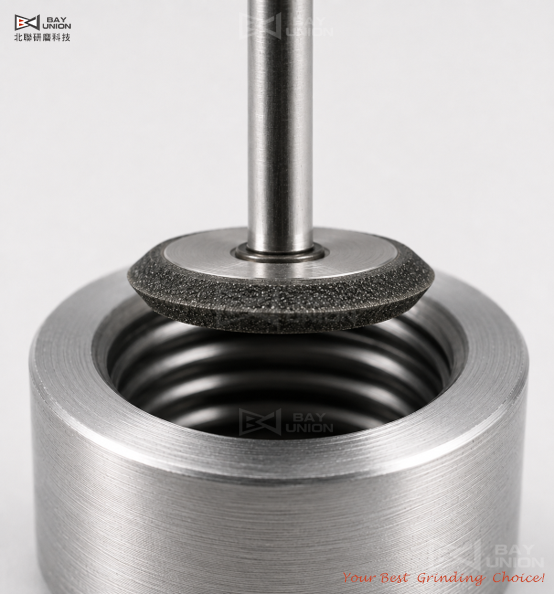
Micro internal-thread grinding combines wheel-profile accuracy, quill stability, thermal control, and a repeatable dressing strategy.
Grinding Capability Becomes a Supply-Chain Advantage
The move toward mass-produced humanoid robots is, at its core, a reshaping of advanced manufacturing. Suppliers that master grinding-wheel formulation, thermal management, wheel-profile control, and dressing technology will be better positioned to unlock repeatable production of high-value joint components. In this emerging supply chain, grinding knowledge is not simply a tooling choice - it is a production capability.
Bay Union Solutions for Micro-Thread Grinding
For micro-thread and precision internal-grinding applications, Bay Union can develop multiple grinding-wheel specifications tailored to the workpiece material, required profile, machine configuration, and production target. Our objective is to help customers establish a stable grinding process, improve repeatability, and accelerate qualification into the robotic-component supply chain.
Discuss your application with Bay Union
Send your workpiece material, thread geometry, target tolerance, machine model, and current grinding challenge to sales@bayunion.com.tw.