

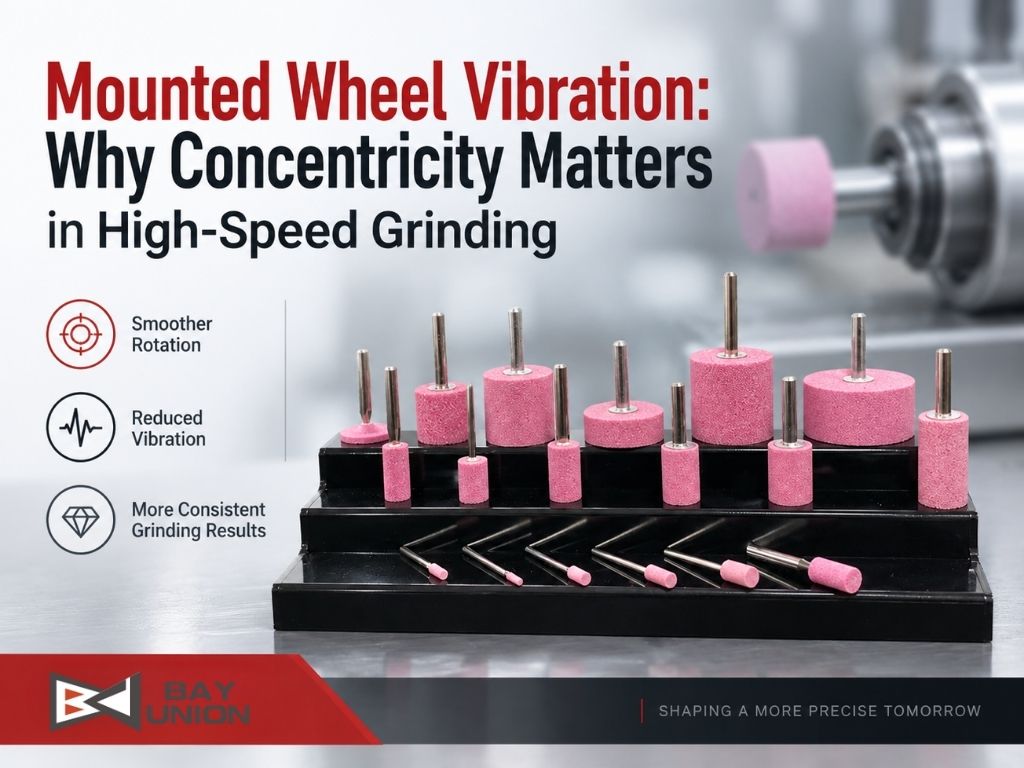
Mounted Wheel Vibration: Why Concentricity Matters in High-Speed Grinding
Mounted wheels are widely used for deburring, internal grinding, mold finishing, and precision surface correction, especially in areas where larger grinding wheels cannot easily reach. Because these tools consist of an abrasive wheel mounted on a steel shank and are often operated at high rotational speeds, even small deviations in rotation can affect grinding stability.
One important factor is the concentricity between the grinding wheel and the shank. When these components are accurately aligned, the mounted wheel can rotate more smoothly and maintain more consistent contact with the workpiece. Poor alignment, on the other hand, may contribute to runout, vibration, uneven cutting, and inconsistent surface quality.
This makes concentricity an important consideration when evaluating a mounted wheel for high-speed precision grinding.
Table of Contents
- Quick Answer: Why Does Concentricity Matter in a Mounted Wheel?
- What Is Mounted Wheel Concentricity?
- Why High-Speed Grinding Makes Concentricity More Important
- How Poor Concentricity Can Affect Grinding Performance
- Concentricity vs. Balance: Are They the Same?
- Why the Wheel-to-Shank Connection Matters
- Other Factors That Can Cause Mounted Wheel Vibration
- Quick Troubleshooting Guide for Mounted Wheel Vibration
- Why Concentricity Matters Even More in Precision Applications
- BAY UNION Mounted Wheels for High-Speed Grinding
- Key Takeaways
- FAQ — Mounted Wheel Concentricity and Vibration
Quick Answer: Why Does Concentricity Matter in a Mounted Wheel?
Concentricity matters because it affects how accurately the abrasive wheel rotates around the shank axis.
When the wheel and shank are properly aligned, rotation is smoother and contact with the workpiece is more consistent. Poor concentricity can contribute to radial runout, vibration, uneven cutting, and unstable surface quality.
In high-speed grinding, good concentricity can help support:
- Smoother rotation
- Reduced vibration
- More stable cutting contact
- Consistent surface quality
- More uniform wheel wear
- Better grinding stability
This relationship is particularly important for mounted wheels because the abrasive wheel and steel shank operate together as one rotating assembly.
What Is Mounted Wheel Concentricity?
Mounted wheel concentricity describes how closely the center of the abrasive wheel aligns with the rotational axis of the steel shank.
Ideally, the abrasive wheel and shank share the same centerline.
If the abrasive body is slightly offset from the shank, the grinding surface does not rotate around a perfectly centered path. Instead, part of the wheel may move slightly closer to and farther away from the workpiece during every revolution.
This condition is commonly associated with radial runout.
As runout increases, contact between the mounted wheel and workpiece can become less uniform, potentially creating vibration and uneven grinding behavior.
Why High-Speed Grinding Makes Concentricity More Important
A small alignment error may appear insignificant when a mounted wheel is stationary or rotating slowly. At higher rotational speeds, however, that error is repeated many times per second.
As rotational speed increases:
- Runout occurs more frequently
- Alternating contact forces become more noticeable
- Vibration may become more pronounced
- Surface irregularities can develop more quickly
- Grinding stability may decrease
This is why mounted wheels intended for high-speed rotary tools require more than an appropriate abrasive and grit specification. Stable alignment between the abrasive wheel and steel shank also matters.
How Poor Concentricity Can Affect Grinding Performance
1. Increased Vibration
When the abrasive wheel rotates off-center, the contact force between the wheel and workpiece can change during each revolution.
Instead of maintaining steady contact, the wheel may repeatedly increase and decrease its engagement with the workpiece.
The result can be noticeable vibration, especially at higher rotational speeds.
For precision grinding, this vibration can make it more difficult to maintain a stable grinding path and consistent material removal.
2. Uneven Material Removal
An off-center wheel may cause one portion of the abrasive surface to contact the workpiece more aggressively than another.
This can contribute to:
- Uneven stock removal
- Localized over-grinding
- Difficulty maintaining geometry
- Additional finishing requirements
The effect becomes particularly important when mounted wheels are used for internal features, small surfaces, narrow areas, or localized correction.
3. Inconsistent Surface Finish
A consistent surface finish depends on controlled contact between the abrasive grains and workpiece.
When runout creates intermittent or uneven contact, the finished surface may show:
- Irregular grinding marks
- Uneven roughness
- Localized surface defects
- Reduced finish consistency
Good concentricity helps the abrasive surface engage the workpiece more consistently through each revolution.
4. Uneven Wheel Wear
Poor concentricity can also affect how the mounted wheel itself wears.
If one area of the wheel repeatedly receives a greater grinding load, abrasive wear may become uneven.
Over time, this may contribute to:
- Faster loss of wheel geometry
- Increasing runout
- Reduced usable wheel life
- Greater vibration as wear progresses
Maintaining good wheel-to-shank alignment helps promote more consistent contact around the circumference of the wheel.
Concentricity vs. Balance: Are They the Same?
No. Concentricity and balance are related to rotational stability, but they describe different conditions.
| Factor | Concentricity | Balance |
|---|---|---|
| Main Concern | Geometric alignment | Mass distribution |
| What It Describes | Whether the wheel is centered on the shank axis | Whether mass is evenly distributed around the rotational axis |
| Possible Effect | Runout and uneven contact | Rotational vibration |
| Why It Matters | Helps maintain a consistent grinding path | Helps maintain smooth rotation |
A mounted wheel can theoretically be well centered but have uneven mass distribution. Likewise, mass may be relatively uniform while the abrasive wheel itself is not perfectly centered on the shank.
For mounted wheels, wheel-to-shank concentricity is particularly important because the steel shank establishes the rotational axis of the tool.
Why the Wheel-to-Shank Connection Matters
Unlike a larger grinding wheel mounted directly onto a machine spindle or flange, a mounted wheel consists of an abrasive body permanently attached to a relatively small steel shank.
The two components therefore function as a single rotating tool.
Grinding performance depends not only on:
- Abrasive type
- Grit size
- Bond characteristics
- Wheel shape
- Wheel dimensions
but also on how accurately the abrasive wheel aligns with the shank.
This means a high-quality mounted wheel should maintain a stable relationship between the abrasive body and its steel shank.
Other Factors That Can Cause Mounted Wheel Vibration
Concentricity is important, but not every vibration problem is caused by the mounted wheel itself.
Before replacing the wheel, several other factors should also be checked.
Improper Tool Clamping
If the shank is not properly secured in the collet or tool holder, the mounted wheel may rotate eccentrically even when the wheel itself has good concentricity.
Worn Collet or Spindle
Wear in the spindle, collet, or tool holder can introduce additional runout into the rotating assembly.
Excessive Shank Overhang
The unsupported length of the shank can influence rigidity. Excessive overhang can make the mounted wheel more susceptible to deflection and vibration during grinding.
Excessive Grinding Pressure
Applying excessive force can increase shank deflection and create unstable contact between the wheel and workpiece.
Unsuitable Wheel Size or Shape
A mounted wheel that is poorly matched to the workpiece geometry may create unnecessary grinding forces or make controlled contact more difficult.
Damaged Wheel or Bent Shank
A damaged abrasive body or bent steel shank can cause unstable rotation and should not be used.
Therefore, troubleshooting mounted wheel vibration should consider the entire rotating system, not just the abrasive wheel.
Quick Troubleshooting Guide for Mounted Wheel Vibration
| Symptom | Possible Cause | What to Check |
|---|---|---|
| Vibration begins immediately | Runout or improper clamping | Wheel-to-shank alignment and collet installation |
| Vibration increases as speed rises | Runout, imbalance, or tool-holder issue | Shank, wheel condition, collet and spindle |
| Uneven grinding marks appear | Irregular wheel contact | Runout, wheel condition and grinding pressure |
| Wheel wears more heavily on one side | Uneven loading | Wheel alignment and shank condition |
| Previously stable grinding begins vibrating | Wear or damage | Wheel, shank, spindle and collet condition |
This guide should be treated as a starting point. Grinding parameters, wheel specifications, workpiece material, machine condition, and operating method should also be evaluated before identifying a single cause.
Why Concentricity Matters Even More in Precision Applications
Mounted wheels are often selected precisely because they can reach areas where larger grinding wheels cannot operate effectively.
Typical applications include:
- Internal grinding
- Mold and die finishing
- Small-feature grinding
- Precision deburring
- Local surface correction
- Contour finishing
- Difficult-to-reach grinding areas
In these applications, the grinding contact area may be relatively small and the required material removal highly localized.
This makes uncontrolled movement more significant.
A mounted wheel with good concentricity can help maintain controlled contact between the abrasive surface and workpiece, supporting more predictable grinding results.
BAY UNION Mounted Wheels for High-Speed Grinding
BAY UNION ABRASIVE TECHNOLOGY CO., LTD. provides mounted wheels in different shapes, sizes, grit specifications, and shank dimensions for a range of grinding requirements.
The product range includes Type A, Type B, and Type W mounted wheels:
- Type A is mainly designed for offhand applications in foundries, steel mills, metal fabrication plants, and stone industries.
- Type B is mainly designed for light deburring in tool and die applications.
- Type W supports offhand and precision grinding where medium to heavy stock removal is required.
Across multiple individual mounted wheel products, BAY UNION also highlights:
- Aluminum oxide abrasive
- Steel shanks for rotary tools
- Cutting performance and durability
- Good concentricity between the grinding wheel and shank
- Stable operation with reduced vibration at high speed
For example, the A3 mounted wheel uses 50A Pink Aluminum Oxide, #46 grit, and a Ø6 or Ø6.35 mm shank for tool steel, hardened steel, and bearing steel.
Smaller B44 and B132 products use #80 grit and Ø3 or Ø3.175 mm shanks, while W146 is available with 50A Pink Aluminum Oxide or 40A+ Orange Aluminum Oxide and #100 grit.
This range allows manufacturers to evaluate the mounted wheel according to the required:
Workpiece Material → Grinding Area → Wheel Shape & Size → Grit → Shank Size → Operating Conditions
Rather than focusing on a single specification, the complete grinding application should be considered.
Key Takeaways: Mounted Wheel Concentricity
When evaluating mounted wheel performance, concentricity should not be treated as a minor manufacturing detail.
Good concentricity between the abrasive wheel and steel shank helps support:
- Smoother rotation
- Reduced vibration
- More stable grinding contact
- More consistent material removal
- Better surface consistency
- More uniform wheel wear
However, concentricity alone does not guarantee vibration-free grinding.
The condition of the shank, collet, spindle, tool holder, wheel specification, grinding pressure, and operating conditions should all be evaluated together.
FAQ — Mounted Wheel Concentricity and Vibration
How can I tell if mounted wheel vibration is caused by the wheel or the machine?
Start by checking the mounted wheel for visible damage or a bent shank, then inspect the collet, tool holder, and spindle condition.
If vibration changes significantly after replacing the mounted wheel with a properly installed wheel, the original wheel or shank may be contributing to the problem. If vibration remains, the spindle, collet, tool holder, and overall machine condition should also be investigated.
Does a smaller shank diameter make a mounted wheel more sensitive to vibration?
Shank diameter can influence the rigidity of the mounted wheel assembly, but vibration cannot be determined by shank diameter alone.
Wheel dimensions, shank overhang, rotational speed, grinding pressure, tool-holder condition, and wheel-to-shank concentricity can all affect stability. The mounted wheel and shank specification should therefore be selected according to the actual grinding conditions.
What should I consider when selecting a mounted wheel for high-speed grinding?
Do not select a mounted wheel based only on grit or wheel shape.
Consider the wheel-to-shank concentricity, wheel dimensions, shank diameter, abrasive type, grit size, workpiece material, required surface finish, rotary tool condition, and operating speed.
The mounted wheel should also always be used within the applicable operating and safety requirements.
Conclusion
At high rotational speeds, mounted wheel performance depends on more than abrasive type, grit size, and wheel shape.
Concentricity between the grinding wheel and steel shank plays an important role in maintaining smooth rotation and stable grinding contact.
Poor alignment can contribute to runout, vibration, uneven material removal, inconsistent surface finish, and irregular wheel wear. At the same time, manufacturers should avoid assuming that every vibration problem originates from the wheel itself. Shank condition, clamping, spindle condition, overhang, grinding pressure, and operating conditions should also be investigated.
BAY UNION offers Type A, Type B, and Type W mounted wheels for different grinding requirements, with multiple product specifications emphasizing good wheel-to-shank concentricity and stable high-speed operation.
If you are experiencing vibration or unstable grinding performance, contact BAY UNION ABRASIVE TECHNOLOGY CO., LTD. to discuss your wheel dimensions, shank size, workpiece material, grinding conditions, and application requirements.
Related Articles
How to Choose the Right Mounted Points for Different Grinding Applications
Learn how workpiece material, grinding geometry, grit size, abrasive type, and wheel shape affect mounted point selection for deburring, internal grinding, mold finishing, and precision surface correction.
How to Choose the Right Mounted Wheel for Your Grinding Task
Continue with the broader selection principles behind mounted wheels, including abrasive type, grit size, bond material, wheel shape, shank dimensions, and grinding requirements.
Mounted Wheels: Versatile Grinding Solutions
Explore the fundamentals of mounted wheels, including their characteristics, common applications, Type A, Type B, and Type W differences, and how wheel shape and size relate to different grinding tasks.