
The Role of ID Grinding in Achieving High-Precision Internal Finishes
Introduction
In today’s world of advanced manufacturing, achieving exceptional accuracy and surface quality is no longer optional—it’s essential. Among the many precision machining processes, ID grinding (Internal Diameter Grinding) plays a vital role in ensuring tight tolerances and flawless internal finishes for components across industries such as automotive, aerospace, medical, and bearing production.
At Bay Union Abrasive Technology Co., Ltd., we understand how critical ID grinding is to modern manufacturing, and we’re proud to provide high-performance grinding wheels that meet the exacting demands of this essential process. This article explores the importance of ID grinding, the challenges it addresses, and how to select the right grinding wheel for your application.
What is ID Grinding?
ID grinding, or Internal Diameter grinding, is a precision machining process that removes material from the inside surface of cylindrical workpieces. It is commonly used to achieve highly accurate internal dimensions, excellent roundness, and smooth surface finishes in parts such as:
- Bearing rings
- Bushings
- Tubes and sleeves
- Hydraulic cylinders
- Precision gears
Unlike external grinding, which focuses on the outside diameter, ID grinding targets the inner geometry, which is often more challenging to access and control due to limited space and heat buildup.
Why ID Grinding Matters in Precision Manufacturing
Internal features are often the most critical in determining the functionality, fit, and performance of a component. Here’s why ID grinding is indispensable:
- Ensures tight internal tolerances required for high-performance assemblies
- Achieves exceptional surface finishes that reduce friction and wear
- Maintains concentricity and roundness essential for rotating components
- Allows for the machining of hardened materials that cannot be finished by conventional methods
In industries like aerospace, where every micron matters, or in automotive transmissions, where component life is paramount, ID grinding is the process of choice to meet these stringent requirements.
Precision Levels Achievable with ID Grinding
One of the greatest advantages of ID grinding is its ability to achieve:
- Dimensional tolerances as tight as ±0.001 mm
- Surface roughness (Ra) as low as 0.1 μm
- Perfect concentricity and minimal roundness deviation
Such results are essential for applications where smooth rotational movement, low friction, and high fatigue resistance are key to performance and safety.
How to Choose the Right Grinding Wheel for ID Grinding
Selecting the correct grinding wheel is crucial for achieving the best results in ID grinding. Several key factors must be considered:
1. Abrasive Material
- CBN (Cubic Boron Nitride): Ideal for hardened steels, tool steels, and superalloys. Offers excellent durability and thermal stability.
- Aluminum Oxide (A/WA): Suitable for general-purpose grinding of soft to medium-hard metals.
- Diamond: Recommended for ceramics, carbides, and non-metallic materials.
2. Bond Type
- Vitrified Bond: Provides high rigidity, better form holding, and superior heat resistance—ideal for high-precision applications.
- Resin Bond: Offers flexibility and is often used for smoother finishes or softer materials.
3. Grit Size
- Coarse Grit (80–120): Faster material removal for roughing operations.
- Fine Grit (150–400): For achieving tight tolerances and smooth finishes.
4. Wheel Shape and Structure
The wheel must match the internal geometry of the workpiece and be compatible with machine spindle size, grinding depth, and coolant flow.
Bay Union’s ID Grinding Solutions
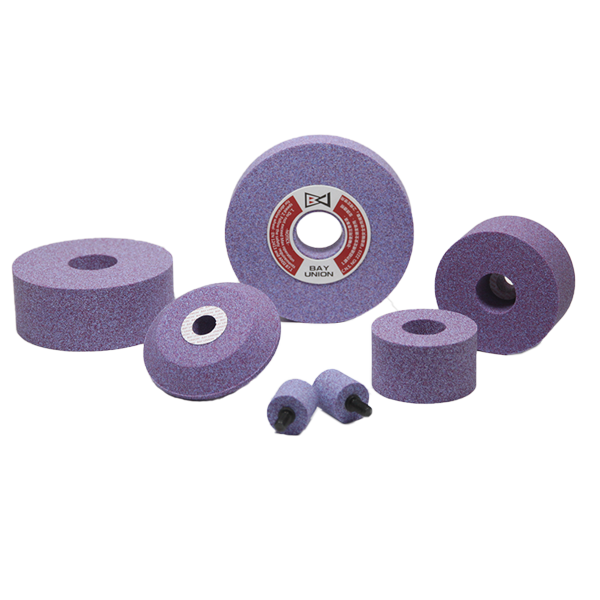
At Bay Union, we are committed to helping manufacturers achieve excellence in ID grinding with our high-performance internal grinding wheels. Our solutions are designed to:
- Deliver exceptional cutting efficiency with minimal wheel wear
- Ensure outstanding dimensional stability and surface finish
- Withstand high-speed grinding environments without thermal damage
- Support both automated and manual internal grinding processes
We offer customized wheel specifications including abrasive type, bond formulation, grit size, and wheel dimensions to meet the unique requirements of your industry—whether it’s bearings, gears, medical devices, or aerospace components.
Real-World Applications of ID Grinding
Bay Union’s ID grinding wheels are used by clients worldwide for applications such as:
- Bearing inner race grinding: Achieving flawless internal diameters for high-speed bearings.
- Gear bore finishing: Ensuring precision fit and longevity in transmission components.
- Medical component grinding: Producing ultra-precise bores in surgical tools and implants.
These applications demand not only high accuracy but also consistency and durability, which Bay Union’s grinding wheels are engineered to provide.
Conclusion
ID grinding is an indispensable process for manufacturers who require precision internal finishes, tight tolerances, and superior surface quality. Choosing the right grinding wheel is essential for maximizing productivity, ensuring part quality, and controlling production costs.
As a leading grinding wheel manufacturer, Bay Union Abrasive Technology Co., Ltd. is proud to offer advanced ID grinding solutions that help our customers meet the most demanding challenges in modern manufacturing.
Whether you're working with hardened steel, ceramics, or specialty alloys, Bay Union has the knowledge, technology, and products to help you succeed.
☞ Explore our full range of internal ID grinding wheels and let us help you optimize your grinding processes.