
Thread Grinding: Achieving High-Precision Threads with Profile Grinding Wheels
Introduction
In industries where motion accuracy, load stability, and repeatable positioning are critical, the quality of threaded components directly affects overall machine performance. From ball screws and worm shafts to precision lead screws and transmission parts, thread geometry must meet extremely tight tolerances to ensure smooth motion, minimal backlash, and long service life.
Thread grinding remains the most reliable finishing method for producing high-precision threads. Compared with turning or rolling, grinding delivers superior dimensional accuracy, surface integrity, and consistent profile replication — especially for hardened materials and high-performance mechanical systems.
As a specialist in vitrified-bond grinding wheels, Bay Union Abrasive Technology supports precision manufacturers with advanced profile grinding wheels engineered specifically for thread grinding stability, accuracy, and efficiency.
What Is Thread Grinding?
Thread grinding is a precision machining process that uses a specially shaped grinding wheel to generate the exact thread profile on a workpiece. Unlike cutting tools that form threads through material displacement, grinding removes microscopic material layers to achieve final geometry and surface finish.
This process is typically applied when:
-
Threads require extremely tight pitch and flank tolerances
-
Workpieces are hardened after heat treatment
-
Superior surface finish is needed to reduce friction and wear
-
High repeatability is required for mass production
Because the grinding wheel carries the negative form of the thread profile, the stability of wheel shape is the key to producing accurate and consistent threads.
Why Profile Grinding Wheels Are Essential for Thread Grinding
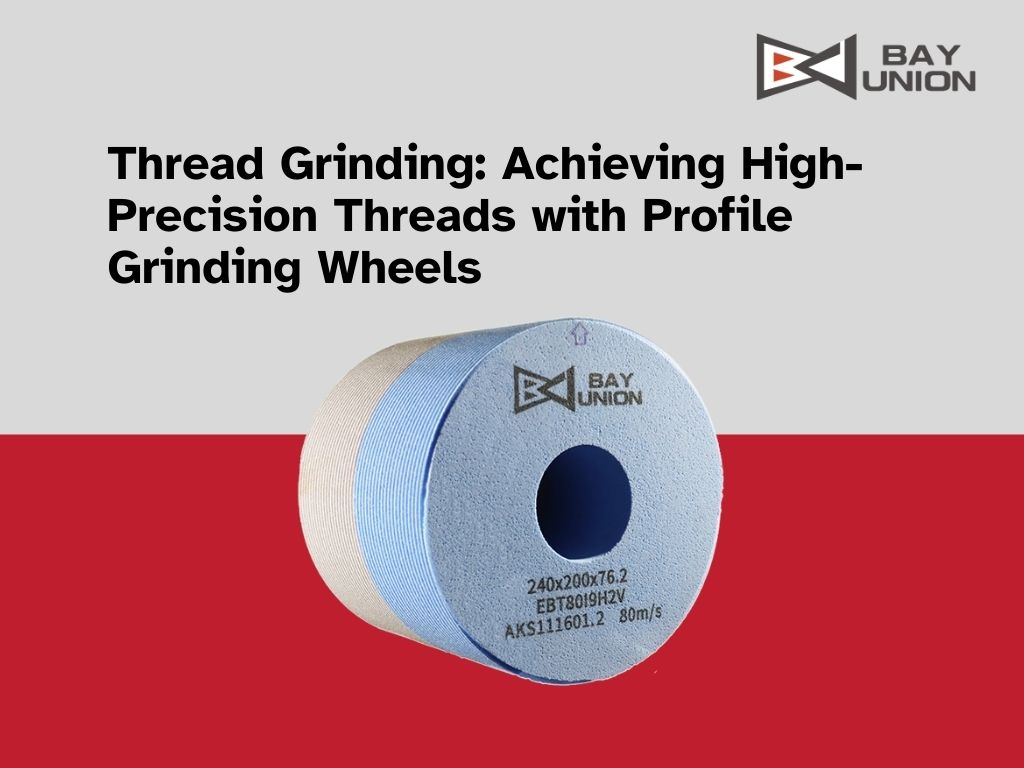
Profile grinding wheels are designed with a precisely dressed wheel form that mirrors the target thread geometry. During grinding, this form is transferred directly onto the workpiece, ensuring high consistency from part to part.
Compared with conventional grinding wheels, profile wheels offer:
-
Exact reproduction of complex thread shapes
-
Stable flank angles and pitch control
-
Minimal form deviation during long production runs
-
Reliable dimensional repeatability
This makes profile grinding wheels indispensable for precision thread manufacturing.
Key Advantages of Thread Grinding
1. Exceptional Dimensional Accuracy
Thread grinding achieves micron-level control of:
-
Pitch accuracy
-
Flank angle geometry
-
Root and crest profiles
-
Concentricity and runout
This is crucial for high-precision assemblies such as linear motion systems, gearboxes, and positioning stages.
2. Superior Surface Finish
Grinding produces smooth thread flanks and roots, reducing friction and improving lubrication performance. This leads to:
-
Lower operating noise
-
Reduced wear
-
Longer service life of mating components
3. Ideal for Hardened Materials
Thread grinding is commonly applied after heat treatment. It allows accurate machining of:
-
Hardened steels
-
Bearing steels
-
Tool steels
-
Alloy and case-hardened materials
Other thread-forming methods struggle to achieve the same accuracy once hardness increases.
4. Consistent Quality in Production
Because the wheel profile remains stable, thread grinding provides:
-
Uniform geometry across batches
-
Reduced part-to-part variation
-
Lower scrap rates
-
Higher process capability (Cpk)
Common Applications of Thread Grinding
Thread grinding is widely used in manufacturing:
-
Ball screws and lead screws
-
Worm gears and worm shafts
-
Precision spindles
-
Thread gauges and calibration tools
-
Transmission and actuator components
These parts demand exact motion control, load stability, and repeatable accuracy — all achievable through profile grinding.
Selecting Profile Grinding Wheels for Thread Grinding
Successful thread grinding depends on choosing the correct wheel specification:
-
Bond type – Vitrified bonds provide strong form retention and thermal stability
-
Grit size – Fine grit for smooth surface finish, coarser grit for stock removal
-
Wheel structure – Controlled porosity improves coolant flow and heat dissipation
-
Form accuracy – Precise dressing ensures exact thread profile transfer
Matching these parameters to material type and machine conditions ensures optimal results.
Bay Union’s Profile Grinding Wheels for Thread Grinding
For precision thread manufacturing, the grinding wheel’s ability to maintain form accuracy is critical. Bay Union specializes in vitrified-bond profile grinding wheels engineered for stable geometry, consistent cutting behavior, and long service life in thread grinding operations.
Our profile grinding wheels are designed to:
-
Maintain precise wheel form for accurate thread flank geometry
-
Deliver stable cutting action on hardened and alloy steels
-
Support efficient coolant penetration to reduce thermal deformation
-
Provide consistent surface finish during long production cycles
They are widely used in manufacturing:
-
Ball screws and lead screws
-
Worm shafts and transmission threads
-
Precision threaded spindles
-
Gauge and calibration threads
With proprietary vitrified bonding technology and in-house wheel forming expertise, Bay Union helps manufacturers achieve tighter tolerances, extended wheel life, and improved process stability in thread grinding operations.
Practical Process Tips for Stable Thread Grinding
To maximize performance in thread grinding:
-
Maintain consistent wheel dressing intervals to preserve profile accuracy
-
Ensure proper coolant targeting to control grinding temperature
-
Match wheel porosity to heat load for burn prevention
-
Use in-process gauging to monitor pitch and flank geometry
These measures significantly improve repeatability and reduce adjustment time.
Conclusion
Thread grinding remains the gold standard for producing high-precision threads in modern manufacturing. By combining exact profile replication, controlled material removal, and superior surface integrity, it ensures the accuracy and durability required in critical mechanical systems.
At the heart of this process, profile grinding wheels determine the final thread quality. Selecting wheels with strong form stability and consistent cutting performance is essential for achieving reliable production and long-term cost efficiency.
Bay Union’s vitrified-bond profile grinding wheels are developed to meet these demands — enabling manufacturers to produce precise, durable, and high-performance threaded components with confidence.
Ready to improve your thread grinding process?
Explore profile grinding wheel solutions or reach out for application guidance. We’re here to help you achieve stable accuracy, higher productivity, and superior thread quality.