
How Wheel Structure and Bond Type Affect ID Grinding Performance
Internal diameter grinding — commonly known as ID grinding — is one of the most precision-sensitive grinding operations. Compared with surface or external cylindrical grinding, it uses smaller wheels, works in confined cutting zones, and faces greater challenges in heat and chip control. Because of this, grinding wheel design plays a much larger role in process stability than many users expect.
While abrasive type and grit size are important, real ID grinding performance is often determined by two deeper factors: wheel structure and bond type. When these are properly matched to the application, they help stabilize bore size, improve surface finish, and reduce thermal damage. When they are not, issues such as burning, loading, glazing, and size variation appear quickly.
This article explains how structure and bond affect ID grinding results and how to evaluate them in practical terms.
Why ID Grinding Requires More Careful Wheel Selection
ID grinding presents several built-in process limitations:
-
Coolant has limited access inside the bore
-
Chip evacuation space is restricted
-
Wheel diameters are small and speeds are high
-
Contact pressure is concentrated
-
Bore tolerances are often tight
Because heat and chips are harder to remove, the wheel must cut efficiently while maintaining openness and form stability. That balance comes mainly from structure and bond design — not grit size alone.
What Wheel Structure Really Means
Wheel structure describes how densely abrasive grains are packed and how much pore space exists between them.
In practical terms:
-
Dense structure → stronger grain support and longer form holding
-
Open structure → more chip space and better cooling
Structure Effects in ID Grinding
In internal grinding, structure strongly influences temperature and cutting behavior.
A more open structure generally helps:
-
Improve chip clearance
-
Reduce loading
-
Lower grinding temperature
-
Decrease burn risk
-
Maintain freer cutting action
A structure that is too dense may:
-
Trap chips in the grinding zone
-
Increase friction heat
-
Promote glazing
-
Cause unstable finishes
However, more open is not always better. If the wheel is too open, grain support drops and dimensional control can suffer. The correct structure is a balance based on bore size, material, and removal rate.
Bond Type: How Grain Retention Changes Cutting Behavior
The bond type determines how abrasive grains are held and released during grinding. This directly affects:
-
Cutting aggressiveness
-
Heat resistance
-
Form holding ability
-
Dressing response
-
Wear pattern
Different bond systems produce very different ID grinding behavior.
Vitrified Bond (Ceramic Bond)
Vitrified bond is widely used in precision ID grinding because it offers a strong balance of rigidity, porosity control, and thermal stability.
Typical advantages include:
-
Good dimensional stability
-
Strong form holding
-
Predictable dressing behavior
-
Controlled porosity design
-
Stable long-run performance
It is commonly used for precision bores in bearings, gears, tooling components, and other tolerance-critical parts.
Resin Bond
Resin bond wheels typically provide a softer cutting feel and lower grinding forces.
They are often selected when:
-
A fine finish is required
-
Cutting pressure must be reduced
-
The operation is relatively light
-
Superabrasives are used for finishing
Their trade-offs include lower heat resistance and faster wear in small, high-speed ID grinding wheels. Form holding is also generally lower than vitrified bond.
Metal Bond (Specialized Superabrasive Use)
Metal bond systems are mainly used with diamond or CBN abrasives for very hard materials.
They offer:
-
Strong grain retention
-
Long service life
-
Good performance on carbide and ceramics
But in precision ID grinding they can be less forgiving because dressing is more difficult and cutting action is more rigid. They are usually chosen based on material requirements rather than general bore finishing.
Structure and Bond Must Work Together
In real applications, structure and bond should be considered together rather than separately.
For example:
-
A vitrified wheel can be engineered with either dense or open structure
-
Bond strength can be adjusted for faster grain release or longer holding
-
Porosity can be increased for deep bore grinding
-
Bond behavior can be tuned for size control vs cutting sharpness
This is why two wheels with the same abrasive and grit can perform very differently in the same ID grinding process.
Small ID Wheels Are More Sensitive to Design
Small internal grinding wheels and mounted wheels are especially sensitive to design details because:
-
Heat builds quickly
-
Contact area is small
-
Spindle speeds are high
-
Wheel mass is low
Uniform structure, consistent bond distribution, and stable grain dispersion become more important as wheel diameter decreases. Small design differences can lead to noticeable process variation.
Application-Matched ID Grinding Wheels
Grinding wheels designed specifically for internal applications are typically built to support:
-
Tight bore tolerances
-
Stable surface finishes
-
Reduced thermal impact
-
Controlled cutting forces
-
Reliable dressing behavior
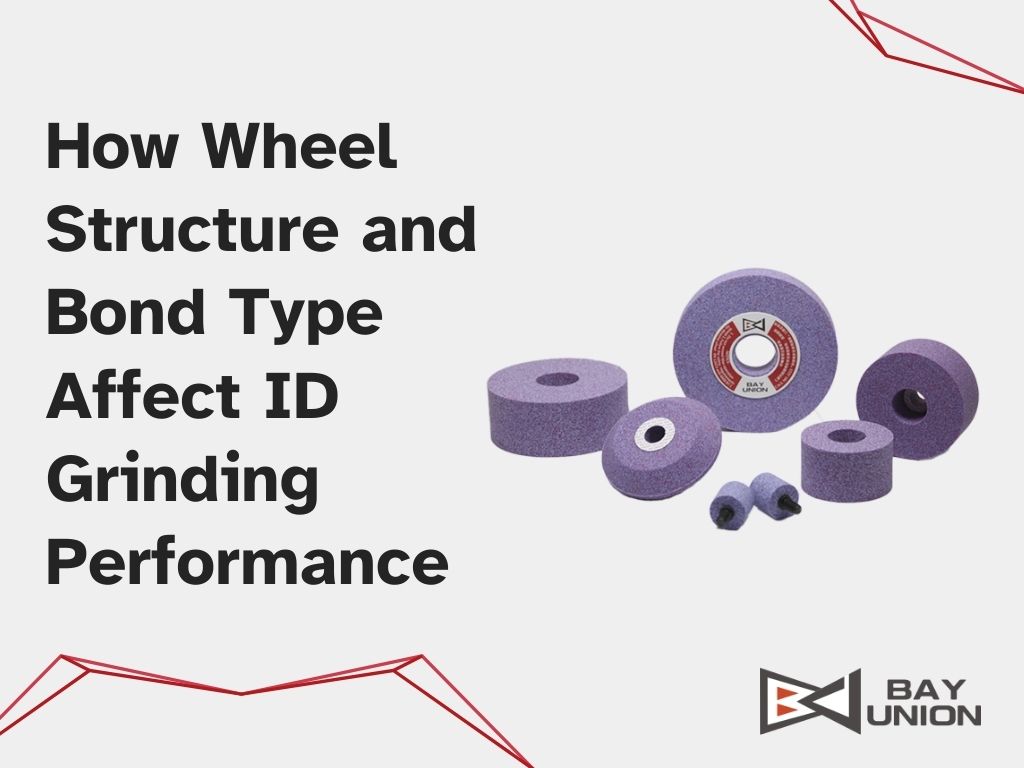
This is also the design direction behind the Internal ID Grinding Wheels product range from BAY UNION ABRASIVE TECHNOLOGY CO., LTD., where wheel structure and bond systems are configured around internal bore grinding conditions rather than general-purpose use.
FAQ — Structure & Bond in ID Grinding
Q1: Why is ID grinding more prone to burning?
Because heat and chips are trapped more easily inside a bore. Wheel openness and bond behavior directly affect temperature control.
Q2: Should I always choose a more open structure to prevent loading?
Often it helps, but too open can reduce dimensional stability. The correct level depends on the application.
Q3: Does finer grit always give better finish?
Not necessarily. Structure, bond behavior, and dressing condition also strongly influence finish.
Q4: Why is dressing consistency important in ID grinding?
Small wheels dull faster. Predictable dressing helps maintain cutting sharpness and bore accuracy.
Conclusion
In ID grinding, performance depends less on grit size alone and more on how the wheel is engineered — especially its structure and bond system. These factors control heat, chip flow, cutting stability, and dimensional repeatability inside the bore.
If your ID grinding process is experiencing burn marks, loading, unstable bore size, or inconsistent finishes, reviewing wheel structure and bond type is often one of the most effective improvement steps.
For application-based recommendations on internal grinding wheels, you can contact BAY UNION. with your material, bore size, and process conditions to evaluate a more suitable wheel specification.