
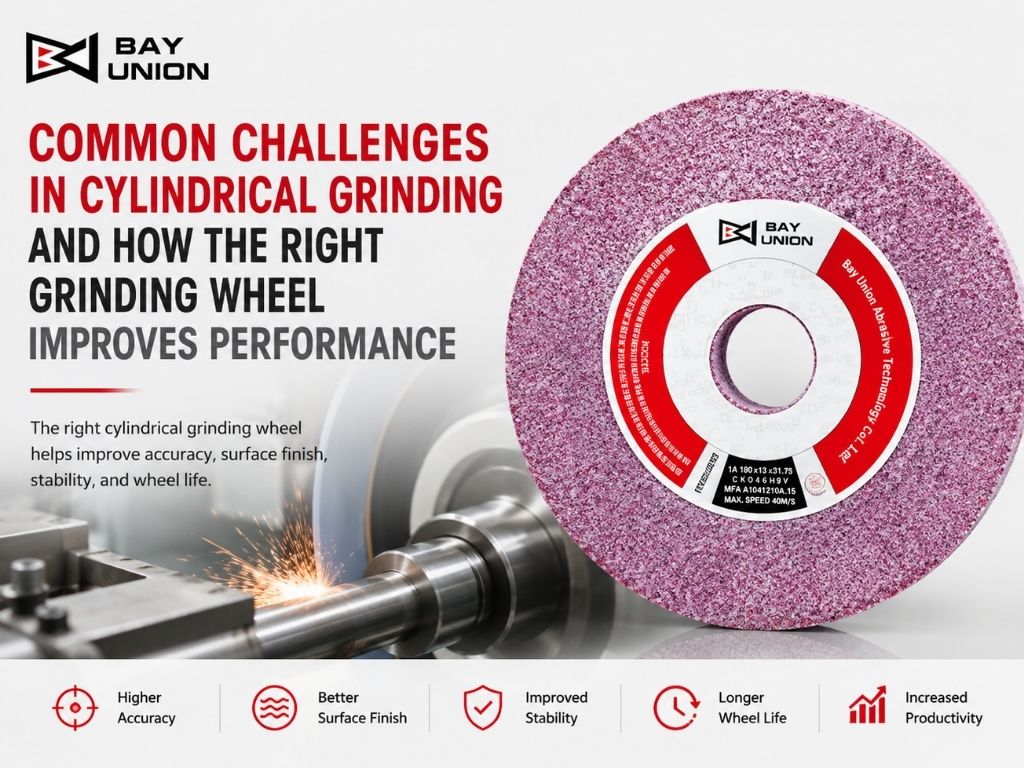
Common Challenges in Cylindrical Grinding and How the Right Grinding Wheel Improves Performance
Cylindrical grinding is widely used to manufacture precision shafts, bearing journals, hydraulic components, and other cylindrical parts that require tight dimensional tolerances and excellent surface finishes. Although modern cylindrical grinding machines provide exceptional accuracy, grinding performance ultimately depends on the interaction between the machine, process parameters, and the grinding wheel.
Many common grinding issues—including poor roundness, unstable surface finishes, excessive wheel wear, and vibration—can often be traced back to an unsuitable grinding wheel specification. Selecting the right cylindrical grinding wheel helps improve process stability, increase productivity, and achieve more consistent part quality.
This article explores the most common challenges in cylindrical grinding and explains how choosing the appropriate grinding wheel can improve overall performance.
Quick Answer: How Can the Right Cylindrical Grinding Wheel Improve Grinding Performance?
The right cylindrical grinding wheel improves grinding performance by maintaining dimensional accuracy, producing a more consistent surface finish, reducing wheel wear, and minimizing grinding defects such as chatter, taper, and thermal damage. Selecting the correct abrasive, grit size, bond type, and wheel structure allows manufacturers to optimize grinding efficiency while extending wheel life.
Why Grinding Wheel Selection Matters in Cylindrical Grinding
Unlike many machining processes, cylindrical grinding removes only a small amount of material while maintaining extremely tight tolerances.
As a result, the grinding wheel directly influences:
-
Material removal efficiency
-
Surface finish quality
-
Roundness
-
Cylindricity
-
Wheel life
-
Process stability
Even a highly accurate grinding machine cannot consistently produce quality parts if the grinding wheel is not properly matched to the application.
Challenge 1: Poor Roundness and Dimensional Accuracy
The Problem
Roundness errors can occur because of:
-
Wheel wear
-
Wheel imbalance
-
Improper dressing
-
Incorrect wheel specification
These problems may prevent parts from meeting dimensional tolerance requirements.
How the Right Grinding Wheel Helps
A grinding wheel with stable form retention and consistent cutting characteristics helps maintain:
-
Better roundness
-
Improved cylindricity
-
More consistent dimensional accuracy
This is especially important when grinding bearing journals, shafts, and precision mechanical components.
Challenge 2: Inconsistent Surface Finish
The Problem
Surface finish directly affects:
-
Wear resistance
-
Fatigue life
-
Bearing performance
-
Sealing capability
An inconsistent surface finish often results from:
-
Incorrect grit size
-
Wheel loading
-
Uneven wheel wear
-
Poor dressing conditions
How the Right Grinding Wheel Helps
Selecting an appropriate grit size and wheel specification helps produce:
-
Lower surface roughness
-
More uniform finishes
-
Stable grinding performance throughout production
For precision components, maintaining a consistent finish is just as important as achieving dimensional accuracy.
Challenge 3: Excessive Wheel Wear
The Problem
Rapid wheel wear increases:
-
Dressing frequency
-
Production downtime
-
Tooling costs
-
Process variation
Aggressive grinding conditions often accelerate wheel wear, especially when grinding hardened materials.
How the Right Grinding Wheel Helps
A properly selected cylindrical grinding wheel offers:
-
Better wear resistance
-
Stable cutting performance
-
Longer wheel life
-
Reduced dressing intervals
This allows manufacturers to increase productivity while lowering operating costs.
Challenge 4: Chatter and Grinding Vibration
The Problem
Grinding chatter can create:
-
Visible vibration marks
-
Surface waviness
-
Dimensional inconsistency
-
Reduced part quality
Chatter may result from machine rigidity, setup conditions, or an unsuitable grinding wheel.
How the Right Grinding Wheel Helps
A well-balanced grinding wheel with consistent structure helps stabilize the grinding process by reducing vibration and maintaining smoother cutting action.
Proper dressing and wheel specification also contribute to improved grinding stability.
Challenge 5: Heat Generation During Grinding
The Problem
Grinding generates significant heat because of friction between the wheel and workpiece.
Excessive heat may lead to:
-
Thermal deformation
-
Surface burn
-
Dimensional instability
-
Reduced workpiece quality
How the Right Grinding Wheel Helps
Grinding wheels designed with optimized abrasive distribution and wheel structure help improve cutting efficiency and reduce grinding forces.
Lower grinding forces generally produce:
-
Better heat control
-
More stable grinding conditions
-
Improved workpiece quality
Quick Guide: Selecting the Right Cylindrical Grinding Wheel
| Grinding Requirement | Recommended Wheel Characteristic |
|---|---|
| Better Roundness | Stable form retention |
| Fine Surface Finish | Fine grit specification |
| Higher Productivity | Longer wheel life |
| Reduced Wheel Wear | Appropriate abrasive and bond |
| Better Heat Control | Optimized wheel structure |
| Improved Process Stability | Balanced wheel design |
Choosing a grinding wheel should always consider the workpiece material, grinding parameters, and quality requirements rather than focusing on only one specification.
Industries That Depend on Cylindrical Grinding Wheels
Cylindrical grinding wheels are widely used across precision manufacturing industries.
Typical applications include:
Bearing Manufacturing
Grinding bearing races and journals requires exceptional dimensional consistency and surface quality.
Automotive Components
Transmission shafts, camshafts, crankshafts, steering components, and precision drive parts all rely on cylindrical grinding.
Industrial Machinery
Rollers, hydraulic cylinders, guide shafts, and precision spindles require accurate external grinding to ensure reliable operation.
Tool Manufacturing
Precision tooling often requires cylindrical grinding to achieve tight tolerances and excellent surface finishes.
Why Manufacturers Choose BAY UNION Cylindrical Grinding Wheels
At BAY UNION ABRASIVE TECHNOLOGY CO., LTD., cylindrical grinding wheels are engineered to support high-precision OD grinding applications across a wide range of industries.
Designed with carefully controlled abrasive distribution and stable wheel structures, Bay Union cylindrical grinding wheels help manufacturers achieve:
-
Consistent grinding performance
-
Excellent dimensional accuracy
-
Stable surface finish quality
-
Reliable wheel life
-
Improved production efficiency
Whether grinding shafts, bearing components, automotive parts, or other precision cylindrical workpieces, Bay Union provides grinding wheel solutions tailored to demanding manufacturing environments.
Key Takeaways
When selecting a cylindrical grinding wheel, remember these principles:
-
Match the wheel to the workpiece material.
-
Select the appropriate grit size based on finish requirements.
-
Consider wheel wear and dressing intervals.
-
Prioritize process stability over maximum material removal.
-
Review grinding problems before changing machine parameters.
A properly selected grinding wheel often improves grinding performance more effectively than adjusting machine settings alone.
FAQ — Cylindrical Grinding Wheels
What is a cylindrical grinding wheel used for?
Cylindrical grinding wheels are used to grind the external surfaces of cylindrical workpieces such as shafts, bearings, rollers, and precision mechanical components.
How does wheel selection affect surface finish?
Wheel specification influences abrasive cutting action, wheel wear, and grinding stability, all of which affect the final surface finish.
Why does my grinding wheel wear too quickly?
Rapid wheel wear may result from an unsuitable wheel specification, aggressive grinding conditions, or incorrect dressing practices.
Can the grinding wheel improve dimensional accuracy?
Yes. A properly selected grinding wheel helps maintain wheel geometry and cutting consistency, resulting in better roundness, cylindricity, and dimensional control.
Conclusion
Achieving consistent results in cylindrical grinding requires more than a high-precision machine. Grinding wheel selection has a direct impact on dimensional accuracy, surface finish, wheel life, and overall process stability.
By understanding common grinding challenges and selecting the right cylindrical grinding wheel, manufacturers can reduce production issues, improve efficiency, and achieve more reliable machining results.
If you are looking for cylindrical grinding wheel solutions for precision OD grinding applications, BAY UNION ABRASIVE TECHNOLOGY CO., LTD. offers a comprehensive range of grinding wheels designed to deliver stable performance, long service life, and outstanding grinding quality.
Contact our team today to discuss your grinding requirements and find the most suitable cylindrical grinding wheel for your application.
Related Articles
Cylindrical Grinding Wheels: Precision Shaping Tools
New to cylindrical grinding? Start with this guide to understand how cylindrical grinding wheels work, their key characteristics, and why they are essential for achieving precision in OD grinding applications.
6 Reasons Cylindrical Grinding Wheels Are Essential in Modern Manufacturing
Discover the key advantages of cylindrical grinding wheels, from maintaining dimensional accuracy and surface finish to improving productivity across modern manufacturing industries.
How Cylindrical Grinding Wheels Enhance Camshaft Precision and Performance
Learn how cylindrical grinding wheels contribute to the precision machining of camshafts by improving roundness, surface finish, and dimensional consistency in automotive manufacturing.