

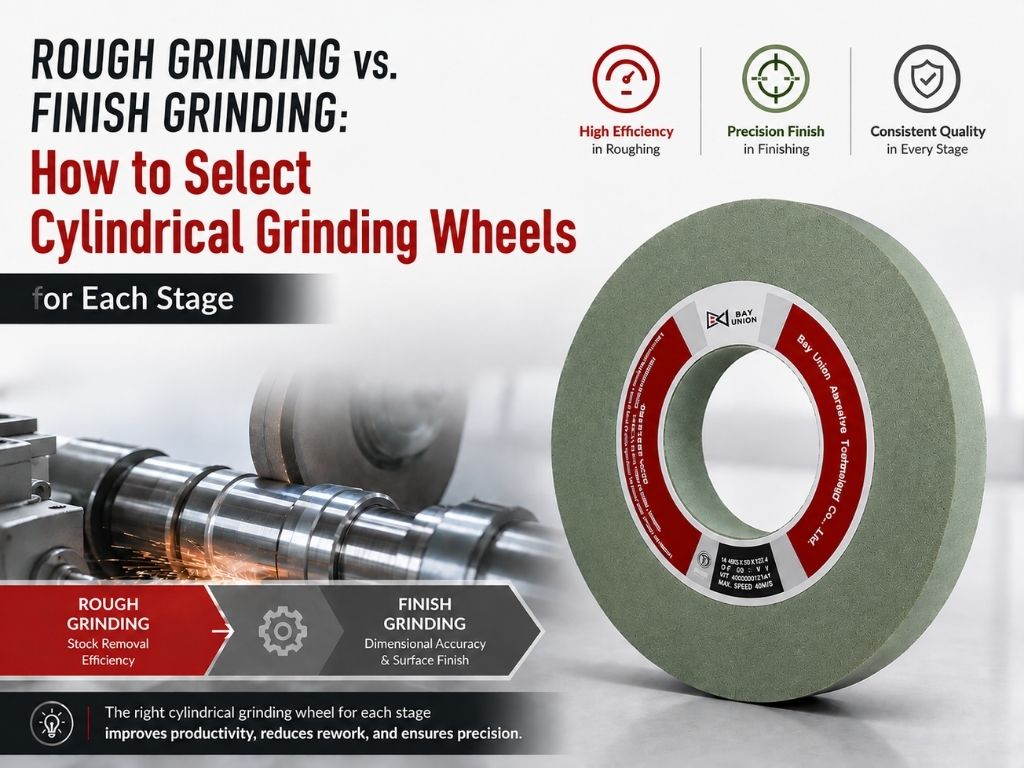
Rough Grinding vs. Finish Grinding: How to Select Cylindrical Grinding Wheels for Each Stage
Cylindrical grinding is rarely a one-step process. In many precision manufacturing applications, manufacturers first need to remove material efficiently and then refine the workpiece to achieve the required dimensional accuracy and surface finish. These two stages—rough grinding and finish grinding—place very different demands on the grinding wheel.
A cylindrical grinding wheel that performs well during heavy stock removal may not be the best choice for achieving a fine surface finish. Likewise, a wheel optimized for finishing may remove material too slowly for an efficient rough grinding operation.
Understanding these differences helps manufacturers select the right cylindrical grinding wheels for each stage, balance productivity and precision, and achieve more consistent grinding results.
Quick Answer: What Is the Difference Between Rough and Finish Grinding?
Rough grinding focuses primarily on removing material efficiently, while finish grinding focuses on achieving final dimensional accuracy and surface quality.
For cylindrical grinding, roughing generally favors a more aggressive cutting action and coarser grit, while finishing typically requires finer grit and more controlled material removal.
The right cylindrical grinding wheel therefore depends not only on the workpiece material but also on where the wheel is used in the grinding process.
| Grinding Factor | Rough Grinding | Finish Grinding |
|---|---|---|
| Primary Goal | Material removal | Final accuracy and surface finish |
| Stock Removal | Higher | Lower |
| Typical Grit Direction | Coarser | Finer |
| Surface Finish Priority | Secondary | High |
| Dimensional Control | Important | Critical |
| Wheel Selection Focus | Cutting efficiency | Precision and finish consistency |
This distinction provides a useful starting point, but actual wheel specifications should always be determined according to the workpiece material, machine conditions, stock allowance, and required finish.
What Is Rough Grinding in Cylindrical Grinding?
Rough cylindrical grinding is the stage where a relatively larger amount of material is removed from the outside diameter of a cylindrical workpiece before final finishing.
The objective is not to produce the final surface quality immediately. Instead, rough grinding prepares the component for subsequent precision grinding by bringing it closer to the required diameter and geometry.
Typical priorities during rough grinding include:
- Efficient stock removal
- Stable cutting action
- Controlled heat generation
- Acceptable wheel wear
- Consistent productivity
Because material removal is the primary objective, the grinding wheel needs sufficient cutting ability to remove stock without generating excessive grinding forces.
What Should You Look for in a Cylindrical Grinding Wheel for Rough Grinding?
A cylindrical grinding wheel for rough grinding should generally prioritize cutting efficiency and chip clearance.
1. Coarser Grit for Higher Material Removal
Coarser abrasive grains generally provide larger cutting edges and more space for chips. This can help increase material removal efficiency when significant stock must be removed before the finishing stage.
However, using an excessively coarse grit may produce a surface that requires more work during subsequent finishing. Manufacturers therefore need to balance stock removal requirements with the amount of finishing that follows.
2. Adequate Chip Clearance
Rough grinding produces more grinding debris because more material is being removed. A wheel structure that provides sufficient chip clearance can help maintain cutting action and reduce loading during continuous grinding.
3. Stable Cutting Performance
Productivity is important during rough grinding, but aggressive cutting should not come at the expense of process stability. The grinding wheel should maintain predictable cutting behavior throughout the operation so manufacturers can achieve consistent stock removal from part to part.
What Is Finish Grinding in Cylindrical Grinding?
Finish cylindrical grinding is performed after most of the excess material has already been removed. Its primary purpose is to bring the workpiece to its final dimensional and surface requirements.
At this stage, manufacturers may need to control:
- Final diameter
- Roundness
- Cylindricity
- Surface roughness
- Dimensional consistency
Because only a small amount of material remains to be removed, the grinding process becomes much more focused on precision than stock removal. This means the requirements for the cylindrical grinding wheel also change.
What Should You Look for in a Cylindrical Grinding Wheel for Finish Grinding?
Finish grinding generally requires a wheel capable of controlled material removal and consistent surface generation.
1. Finer Grit for Better Surface Finish
Finer abrasive grains create smaller cutting marks on the workpiece surface. For applications requiring low surface roughness or a refined final finish, a finer grit is generally more suitable than the coarse grit used during rough grinding.
2. Stable Wheel Geometry
Dimensional accuracy becomes increasingly important as the workpiece approaches its final specification. The grinding wheel therefore needs stable geometry and predictable wear behavior to support consistent diameter, roundness, and surface quality.
3. Controlled Cutting Action
Finish grinding should remove material progressively rather than aggressively. A stable cutting action helps manufacturers avoid unnecessary surface damage while maintaining the required dimensional tolerance.
Why One Cylindrical Grinding Wheel Specification May Not Be Ideal for Both Stages
Using the same cylindrical grinding wheel specification for both roughing and finishing may appear convenient, but it can require compromises.
A wheel optimized for aggressive material removal may:
- Produce a rougher surface
- Require additional finishing passes
- Make final surface control more difficult
On the other hand, a wheel optimized for fine finishing may:
- Remove stock too slowly
- Increase rough grinding cycle time
- Reduce overall production efficiency
For this reason, manufacturers should evaluate whether separate wheel specifications for rough and finish grinding can provide better overall process performance.
The objective is not simply to maximize wheel life or cutting speed. It is to optimize the entire cylindrical grinding process.
How Grit Size Changes Between Rough and Finish Grinding
Grit size is one of the clearest differences between rough and finish grinding wheel selection.
Rough Grinding
A coarser grit is generally preferred when:
- Significant stock must be removed
- Material removal rate is a priority
- Final surface finish will be produced in a later operation
Finish Grinding
A finer grit is generally preferred when:
- Surface roughness is critical
- Only a small amount of material remains
- Dimensional control is the primary objective
However, grit size should never be selected in isolation. Workpiece hardness, abrasive type, wheel structure, bond characteristics, and grinding parameters all influence the final result.
Abrasive, Bond, and Structure Still Matter
Although grit size is an important distinction between rough and finish grinding, it is only one part of cylindrical grinding wheel selection.
Abrasive Type
The abrasive should be matched to the workpiece material and hardness. Different steels and alloys may require different abrasive characteristics to maintain efficient cutting.
Bond System
The bond determines how abrasive grains are retained and released during grinding. Bond behavior influences wheel wear, form retention, dressing response, and cutting characteristics.
Wheel Structure
Wheel structure affects chip clearance, coolant access, and the interaction between abrasive grains and the workpiece.
The best cylindrical grinding wheel specification therefore results from balancing abrasive type, grit size, bond, structure, workpiece material, and grinding stage rather than selecting any single factor independently.
Quick Selection Guide for Rough vs. Finish Cylindrical Grinding
| Requirement | Rough Grinding | Finish Grinding |
|---|---|---|
| Main Objective | Remove stock efficiently | Achieve final dimensions and finish |
| Material Removal | High | Low |
| Grit Selection | Generally coarser | Generally finer |
| Cutting Action | More aggressive | More controlled |
| Chip Clearance | High priority | Important |
| Surface Roughness | Less critical | Critical |
| Dimensional Accuracy | Intermediate control | Final control |
| Wheel Geometry | Stable | Highly stable |
| Process Focus | Productivity | Precision and consistency |
These are general selection principles rather than fixed specifications. Actual wheel selection should be based on the complete grinding conditions.
Common Mistakes When Selecting Cylindrical Grinding Wheels for Rough and Finish Grinding
Choosing Only by Workpiece Material
Material is important, but it does not tell the whole story. Two operations grinding the same steel may require different wheel specifications if one is performing heavy stock removal and the other is producing the final surface finish.
Using an Excessively Fine Wheel for Rough Grinding
A very fine grit may provide good surface quality but reduce stock removal efficiency when used too early in the process.
Using an Excessively Coarse Wheel for Final Finishing
A coarse wheel may remove material efficiently but make it difficult to achieve the required final surface roughness.
Focusing Only on Wheel Life
A wheel that lasts longer is not automatically the most economical solution.
Manufacturers should also consider:
- Cycle time
- Dressing frequency
- Surface quality
- Scrap and rework
- Production consistency
The best wheel is the one that supports the overall production objective.
How BAY UNION Supports Cylindrical Grinding Applications
At BAY UNION ABRASIVE TECHNOLOGY CO., LTD., cylindrical grinding wheel solutions are developed for precision grinding applications involving a variety of steels and industrial components.
Our cylindrical grinding wheel portfolio includes different abrasive formulations, grit sizes, hardness levels, and wheel specifications to support different grinding requirements.
For example, BAY UNION's GF Series is designed for cylindrical grinding of carbon steels and alloy steels, combining cutting ability with wheel life. Depending on the workpiece material, stock removal requirement, surface finish target, and grinding conditions, the appropriate wheel specification can be selected to support different stages of the cylindrical grinding process.
Rather than treating cylindrical grinding wheel selection as a single-variable decision, Bay Union considers the complete application—including workpiece material, grinding stage, required surface finish, dimensional tolerance, machine conditions, and production goals.
This application-based approach helps manufacturers identify a grinding wheel solution that balances productivity, precision, and consistent grinding performance.
Key Takeaways: Rough Grinding vs. Finish Grinding
- Rough grinding prioritizes material removal, while finish grinding prioritizes final accuracy and surface quality.
- Coarser grits are generally more suitable for rough grinding, while finer grits are commonly used for finishing.
- Grit size should always be considered together with abrasive type, bond, wheel structure, and workpiece material.
- A single wheel specification may require compromises if used for both roughing and finishing.
- The most effective wheel selection considers the entire grinding process rather than wheel life or cutting speed alone.
FAQ — Cylindrical Grinding Wheels for Rough and Finish Grinding
Can the same cylindrical grinding wheel be used for rough and finish grinding?
It may be possible in some applications, but one specification may not provide optimal performance at both stages. Rough grinding and finish grinding have different priorities, so separate wheel specifications may provide better productivity and final quality.
What grit is better for rough cylindrical grinding?
Coarser grits are generally preferred for rough grinding because they support faster material removal and provide more chip clearance. The exact grit should still be selected according to the workpiece material and grinding conditions.
Why are finer grits used for finish grinding?
Finer abrasive grains create smaller cutting marks, making them better suited to applications requiring lower surface roughness and controlled final material removal.
Is grit size the only difference between rough and finish grinding wheels?
No. Abrasive type, bond, wheel hardness, structure, dressing conditions, and machine parameters can all influence grinding performance.
How do I determine the right cylindrical grinding wheel specification?
Start with the workpiece material, hardness, stock allowance, required surface finish, dimensional tolerance, machine conditions, and whether the operation is roughing, semi-finishing, or finishing. These factors provide a more reliable basis for wheel selection than grit size alone.
Conclusion
Rough grinding and finish grinding serve different purposes in cylindrical grinding, and the grinding wheel should reflect those differences.
Rough grinding requires efficient material removal and stable cutting performance, while finish grinding requires controlled cutting, dimensional accuracy, and consistent surface quality. Selecting the appropriate cylindrical grinding wheels for each stage can help manufacturers improve productivity without sacrificing the precision required in the finished component.
If you are evaluating cylindrical grinding wheels for roughing, finishing, or a multi-stage grinding process, BAY UNION ABRASIVE TECHNOLOGY CO., LTD. can help you identify a wheel specification based on your workpiece material, grinding conditions, and production requirements.
Contact us to discuss your cylindrical grinding application and find the grinding wheel solution best suited to each stage of your process.
Related Articles
Cylindrical Grinding Wheels: Precision Shaping Tools
Start with the fundamentals of cylindrical grinding wheels, including their characteristics, common applications, and the role of grit size and bond selection in precision grinding.
6 Reasons Cylindrical Grinding Wheels Are Essential in Modern Manufacturing
Explore why cylindrical grinding wheels remain important in modern manufacturing, from tight tolerance control and surface quality to durability, versatility, and production efficiency.
How Cylindrical Grinding Wheels Enhance Camshaft Precision and Performance
See how cylindrical grinding wheel selection affects a specific precision application, including camshaft geometry, surface integrity, material selection, dressing, and production consistency.